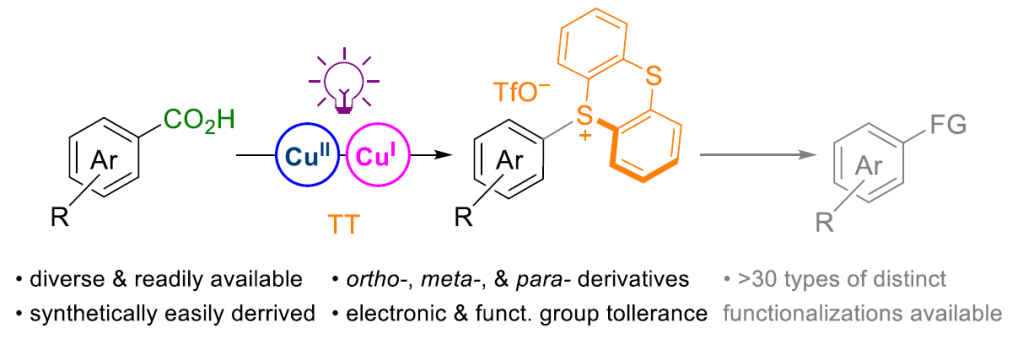
We report a method that enables chemoselective decarboxylative thianthrenation of a broad range of (hetero)aryl carboxylic acids forming high value-added (hetero)aryl thianthrenium salt reagents under mild conditions, creating an attractive two-step pathway for the divergent functionalization of these abundant starting materials, as exemplified here by modifications of a series of pharmaceuticals.
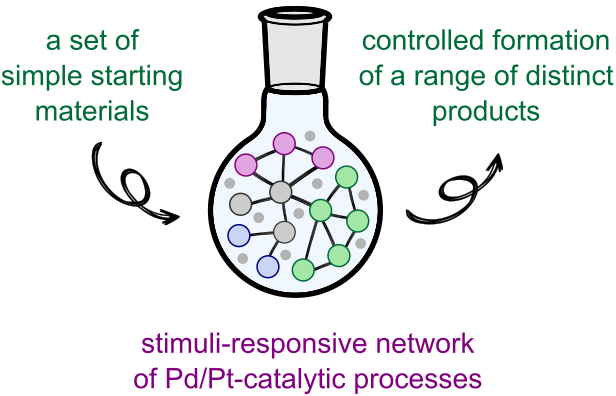
In this paper, we present a metabolism-inspired artificial system designed to respond to multiple stimuli, operating within an integrated network of mechanistically distinct reactions. Our approach enables the efficient performance of multi-stage processes using three simple starting materials, controlled by specific triggers, and catalysed by a multifunctional Pd/Pt complex, leading to the preferential synthesis of ten products.
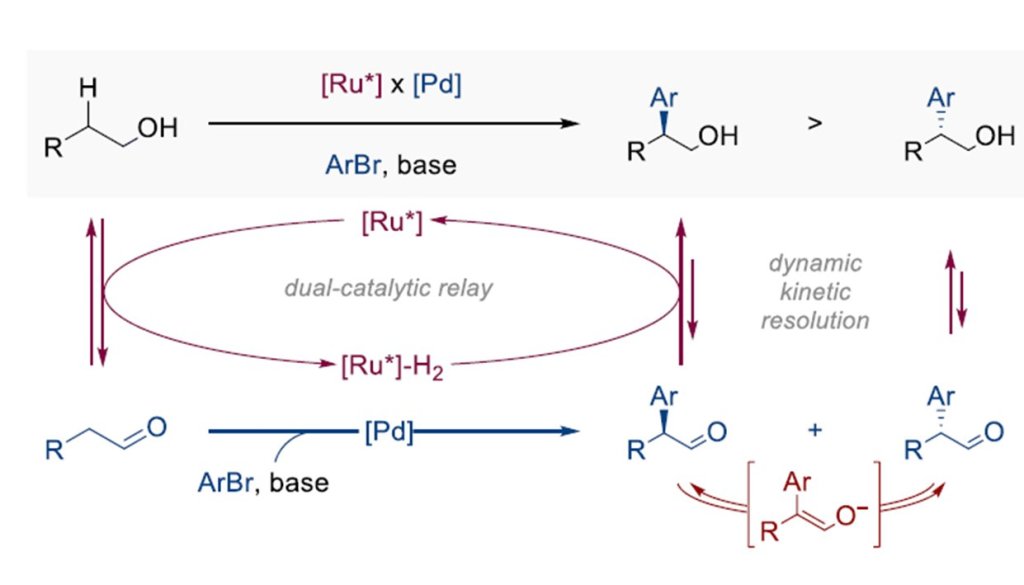
Regio- and enantioselective arylation of unactivated beta-C(sp3)−H bond of primary alcohols was achieved under mild conditions by constructing a cooperative system merging relay catalysis with dynamic kinetic resolution of transient aryl aldehyde intermediates, demonstrating new opportunities in multicatalysis to execute otherwise challenging transformations.
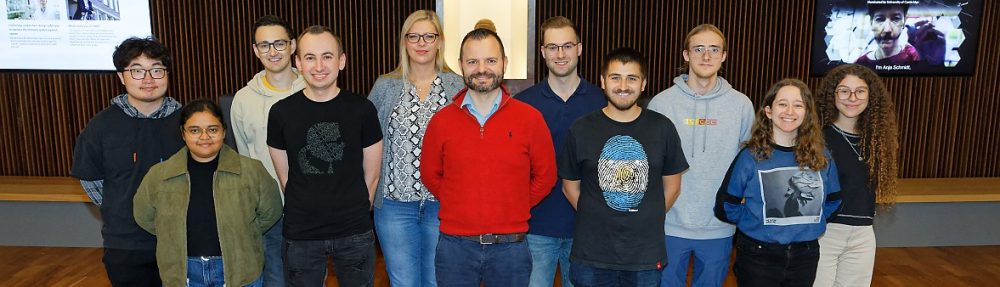
It is our pleasure to announce that the Dydio Group moves to the University of Cambridge from the University of Strasbourg.
After wonderful 7 years at ISIS (Institut de Science et d’Ingénierie Supramoléculaires) the Dydio Group has moved to the Yusuf Hamied Department of Chemistry at the University of Cambridge.
We would like to thank all the present and former group members for their dedicated work, all the members of ISIS for providing a stimulating environment for research and all the technical and administrative staff for their constant help!
We are looking forward to continue our research at the Yusuf Hamied Department of Chemistry and are excited to meet all the researchers at the University of Cambridge.
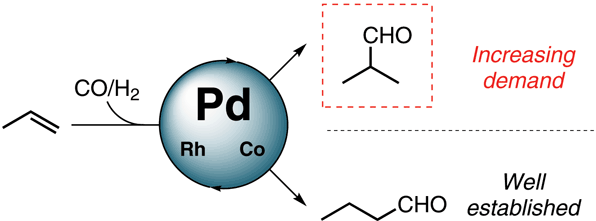
The hydroformylation of simple aliphatic alkenes, such as propylene, is one of the largest homogenous catalyzed processes in the chemical industry, producing over 10 million metric tons of different aldehydes each year. Typically, such processes are catalyzed by Co or Rh catalysts, yielding mostly linear aldehydes, such as n-butanal. However, the increasing demand for branched aldehydes, such as isobutanal, triggered further investigation to develop efficient isoselective protocols, which remain scarce. In this Synpacts article, we discuss our recent work on iodide-assisted Pd catalysis as an attractive alternative strategy for the development of isoselective methods. This article is presented considering the state of the art for Rh-catalyzed processes. Additionally, we discuss the limitations and challenges that need to be addressed in order to successfully transfer the technology to industry.
In this article we highlight the recent studies by the laboratories of Hartwig, Scott, and Guironnet, which demonstrated that ingenious cascades of reactions driven by catalysts operating in concert enable conversion of ethylene and polyethylene (PE) materials, the largest plastic waste contributor, into propylene, the valuable olefin used in the synthesis of various chemicals and commodity materials.
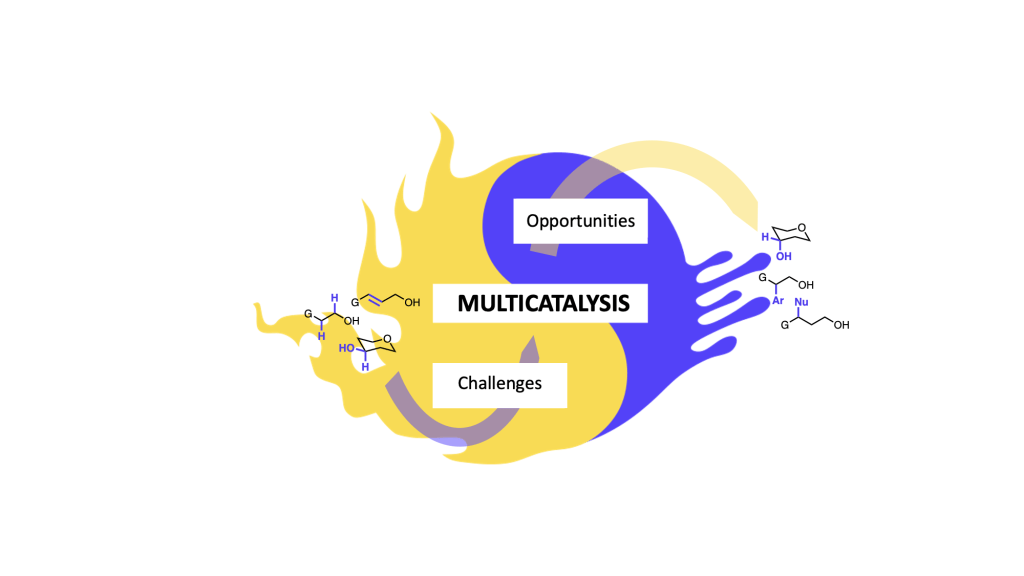
Given that alcohol moieties are present in a great diversity of valuable fine chemicals from nature and synthesis, methods enabling their structure diversification are highly sought after. Catalysis proved to enable the development of new transformations that are beyond the inherent reactivity of alcohols. However, modifying the structure of alcohols at certain unbiased positions remains a major challenge or requires tedious multistep procedures. Recently, increased attention has been given to multicatalyis, which combines multiple reactions and catalysts within one system, creating room for discovering previously inaccessible reactivities or increasing the overall efficiency of multistep transformations. This feature article focuses on demonstrating various aspects of devising such multicatalytic systems that modify the structure of alcohol-containing compounds. Special attention is given to highlighting the challenges and advantages of multicatalysis, and in a broader context discussing how the field of catalysis may progress toward more complex systems.


 The Dydio Group