New Selectivity Control
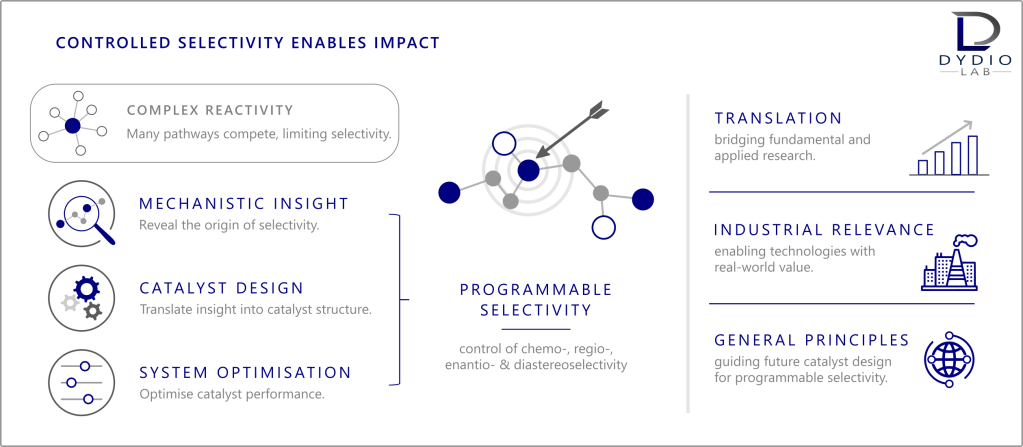
Many established catalytic processes are highly attractive because they convert simple and readily available starting materials into valuable products. However, their broader synthetic potential is often restricted by incomplete control over competing reaction pathways and, consequently, over chemo-, regio-, enantio- and diastereoselectivity.
We seek to develop a mechanistic understanding of such important processes and use it to address their fundamental limitations. By identifying how catalyst structure, speciation and elementary reactivity determine the outcome of a reaction, we aim to design catalytic systems in which selectivity can be controlled deliberately and, ultimately, divergently.
Carbonylation chemistry provides a particularly attractive model for this approach. Carbonylation reactions can combine simple alkenes, carbon monoxide, hydrogen and suitable nucleophiles, including alcohols, amines, thiols and water, to access aldehydes, esters, amides, thioesters and carboxylic acids. These reactions are highly atom-efficient and synthetically versatile, but their full potential depends on the ability to control which product is formed, where functionalisation occurs and which stereoisomer is obtained.
Our work on palladium catalysis has shown that mechanistic insight, catalyst speciation and ligand design can generate selectivity patterns that are difficult to achieve using established carbonylation systems. This includes iodide-assisted palladium catalysis for selective hydroformylation, isoselective hydroformylation of simple aliphatic alkenes, and regio- and enantioselective alkoxycarbonylation of unactivated terminal alkenes.
These studies connect fundamental organometallic chemistry with the development of synthetically and industrially relevant processes. Our broader ambition is to establish general principles for controlling selectivity in catalytic reactions, enabling divergent access to structurally distinct products from common and simple starting materials.
Selected developments arising from this research have been protected through patent applications and are being advanced through translational research with industrial partners.
Representative Publications
- Y. Zhang, S. Torker, M. Sigrist, N. Bregovic and P. Dydio, Binuclear Pd(I)–Pd(I) Catalysis Assisted by Iodide Ligands for Selective Hydroformylation of Alkenes and Alkynes, Journal of the American Chemical Society 2020, 142, 18251–18265.
- M. Sigrist, Y. Zhang, C. Antheaume and P. Dydio, Isoselective Hydroformylation of Propylene by Iodide-Assisted Palladium Catalysis, Angewandte Chemie International Edition 2022, 61, e2021164.
- M. Sigrist, K. Das, G. Kurpik, W. Tian, J. Huang, A. Covas, A. D. Bond, W. Tang and P. Dydio, Regio- and Enantioselective Alkoxycarbonylation of Unactivated Terminal Alkenes under Palladium–Bromide–Monophosphine Catalysis, Journal of the American Chemical Society 2026, 148, 26960–26969.
 The Dydio Group