New Catalytic Reactivity
Many readily available molecules are difficult to modify selectively. The most useful positions for their diversification may contain strong, unactivated bonds or may be surrounded by several chemically similar sites.
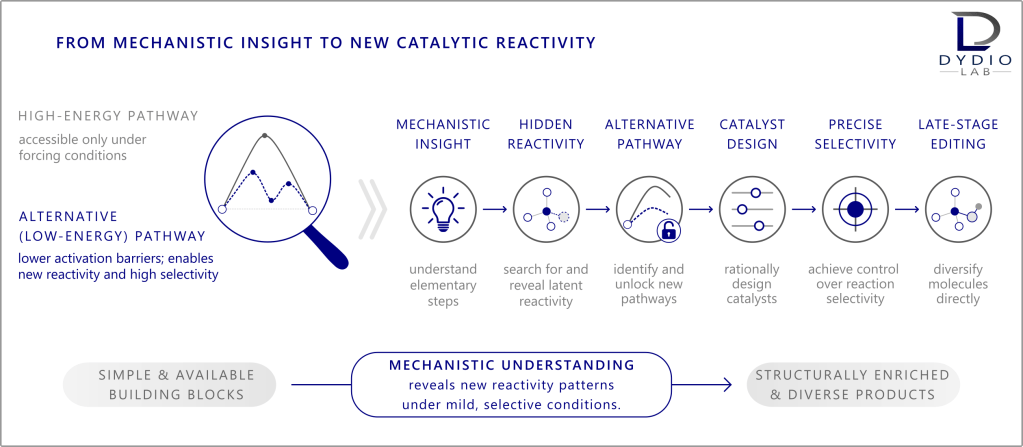
One common way to overcome limited reactivity is to use highly reactive reagents, elevated temperatures or other forcing conditions. However, such conditions often reduce the general utility of a method because sensitive substrates may undergo competing reactions, lose functional-group integrity or decompose.
We therefore seek catalytic strategies that provide precise reactivity under mild conditions. Rather than relying on forcing conditions, we use mechanistic reasoning and detailed insight into elementary reaction steps to identify alternative pathways and design transformations that are difficult to achieve through conventional approaches.
A recurring objective is to convert common functional groups and readily available starting materials into versatile synthetic intermediates while maintaining broad functional-group compatibility. Representative examples from our work include transfer C–H borylation of alkenes and the decarboxylative functionalisation of aromatic carboxylic acids.
We are also interested in selective late-stage functionalisation. Such reactions can enable existing molecules to be diversified directly, reducing the need to redesign and repeat their entire synthesis.
Across these projects, mechanistic studies are used not only to explain observed reactivity, but also to identify new transformations and guide catalyst and reaction design.
Our broader ambition is to uncover new catalytic reactivity that operates selectively under mild conditions and to extend these concepts towards the functionalisation and diversification of increasingly complex molecules.
Representative Publications
- L. Veth, H. Grab, S. Martinez, C. Antheaume and P. Dydio, Transfer C–H Borylation of Alkenes under Rh(I) Catalysis: Insight into the Synthetic Capacity, Mechanism and Selectivity Control, Chem Catalysis 2022, 2, 762–778.
- Z. He and P. Dydio, Photoinduced Cu(II)-Mediated Decarboxylative Thianthrenation of Aryl and Heteroaryl Carboxylic Acids, Angewandte Chemie International Edition 2024, e202410616.
 The Dydio Group